LEO satellite Doppler compensation and time-of-arrival variance.
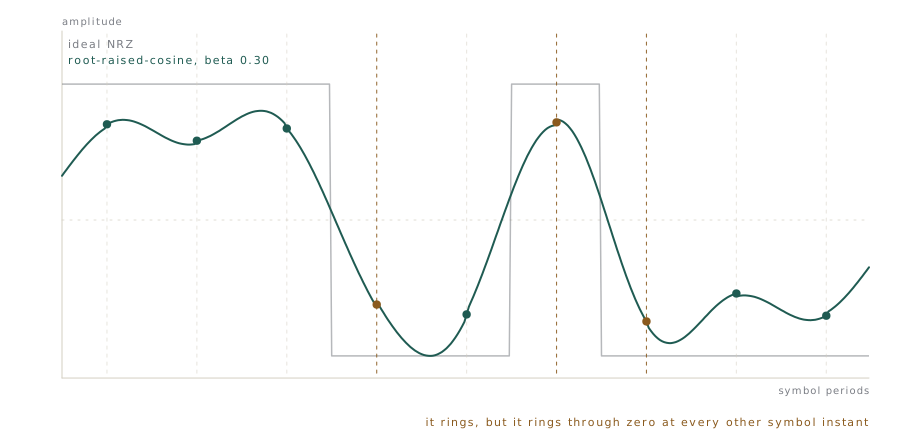
A low-Earth-orbit satellite traverses the visible sky in minutes, and the carrier frequency a ground receiver sees shifts continuously across that pass — tens of kilohertz of Doppler at typical UHF and S-band frequencies, with slew rates that exhaust naive tracking loops. Time-of-arrival also varies as the path length changes, which matters for any system where downstream processing depends on consistent symbol timing or coherent integration.
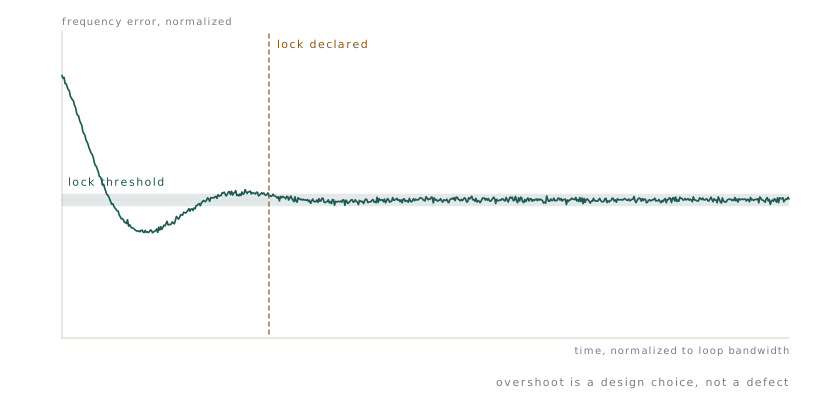
The engineering shape of a solution involves predicting the Doppler curve from orbital elements, designing receiver loops that track the slew rate without losing lock, and decoupling the timing variance from the frequency variance so each can be corrected independently. The work lives in the gap between theoretical link budgets and operational reality — what physics says is possible, and what hardware actually does under noise, multipath, and pointing error. Predicting the curve is half the problem; designing the loops that follow it without breaking is the other half.