Capabilities

Where the engineering depth lives.

Wavelet Solutions operates across four domains. The breadth is deliberate — hard problems tend to sit between specialties, and an engineering practice without depth in adjacent areas misses what those problems actually require. What follows is a candid description of where we work and what we bring to each domain.

Domain I of IV
I
SCADA / ICS / OT

Industrial & infrastructure.

Modernization and hardening of operational technology environments where uptime is non-negotiable and change management is as important as engineering skill. Utilities, manufacturing, water and wastewater, oil and gas. The intersection of legacy hardware, critical uptime, and modern networking is where engineering judgment earns its keep.

SCADA modernization & integration.

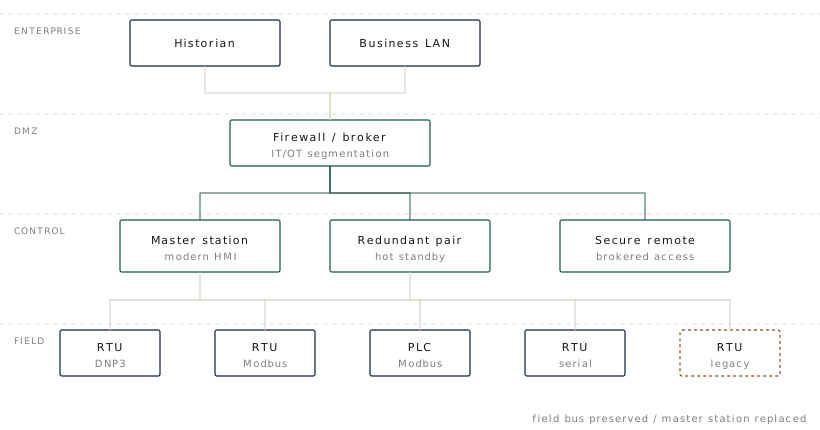
Upgrading legacy SCADA and industrial control systems to modern IP-based architectures without disrupting operations. Preserving what works while adding the monitoring, security, and maintainability aging systems lack — with zero-downtime migration planning from the start.

What this includes
  • IP-based network architecture design and implementation
  • Legacy protocol integration: Modbus RTU/TCP, DNP3, proprietary serial
  • Zero-downtime migration planning and phased rollouts
  • Modern HMI and SCADA visualization platforms
  • Complete system documentation and operator training
Industrial cybersecurity.

Security hardening for OT environments done by an engineer who understands that a patch window does not exist, downtime is unacceptable, and the wrong change can take a plant offline. The threat model and the operational reality have to be reconciled, not chosen between.

What this includes
  • NERC CIP compliance assessment and implementation
  • OT network architecture and IT/OT segmentation
  • ICS security hardening and access controls
  • Vulnerability assessment and remediation planning
  • Secure remote access and VPN design
Domain II of IV
II
TS Cleared / Defense / Aerospace

Defense & government.

Satellite communications, military waveforms, RF systems, and complex program leadership — with an active Top Secret clearance and substantial experience in defense and aerospace programs. The standard applied in defense, where engineering failure means mission failure, transfers cleanly to commercial work.

RF & signal processing.

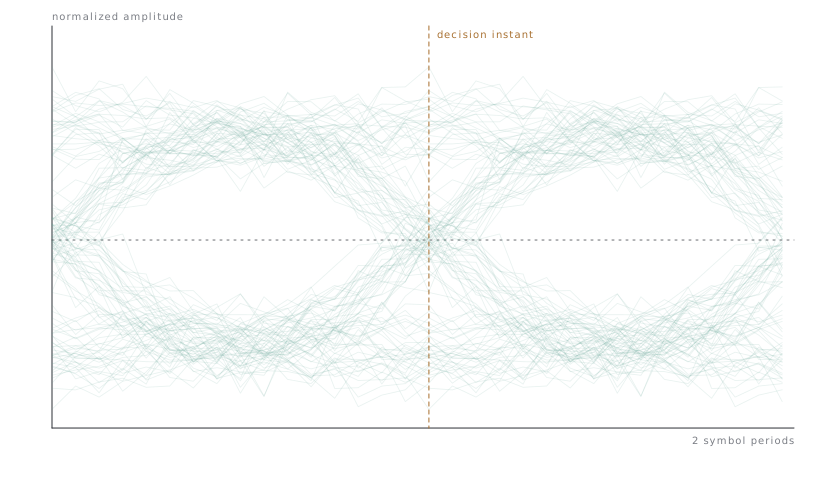
Waveform design, signal detection, satellite link analysis, and software-defined radio development — bridging the gap between theoretical signal work and fielded hardware. The work that lives between physics and protocol.

What this includes
  • Waveform design and analysis: OFDM, DSSS, CPM, FSK
  • Signal detection and classification algorithms
  • Satellite link budget and system analysis
  • SDR development and integration
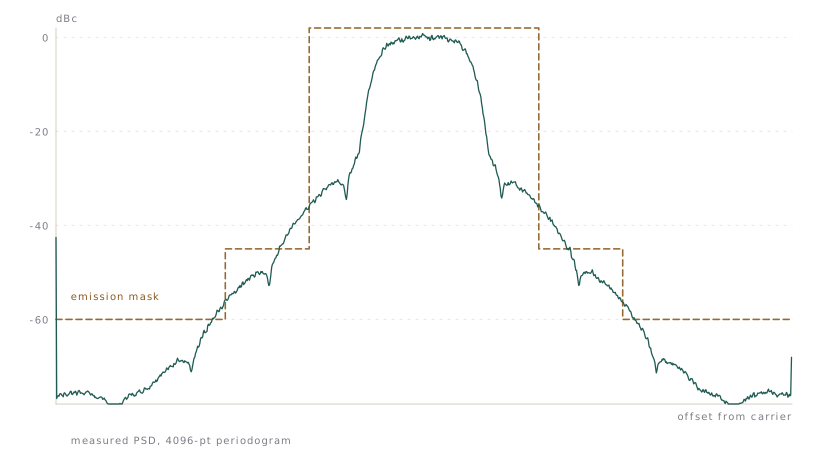
  • NTIA / FCC spectral compliance and RF interference mitigation

Technical program leadership.

Leading complex programs from concept through deployment — technical teams, vendor relationships, integration challenges, evolving requirements. The difference between a technical program manager and a regular one is the ability to get into the work when something is going wrong. The practice does both.

What this includes
  • Program planning, milestone definition, and risk management
  • Technical team leadership and vendor coordination
  • Hands-on integration oversight and troubleshooting
  • Stakeholder communication and reporting
  • Quality assurance and acceptance testing
Domain III of IV
III
Software / Embedded / Firmware

Software & technology.

Greenfield development, rescue of projects that have gone off the rails, and embedded systems work from bare-metal firmware through cloud-connected platforms. Where the discipline of defense-grade work meets the pragmatics of commercial software delivery.

Software development & rescue.

Purpose-built software across domains, and honest recovery of projects that have gone off the rails. Greenfield systems built right from the start or codebases that need a clear path forward — the approach is the same: requirements first, architecture before code, maintainability as a non-negotiable.

What this includes
  • Multi-language development: C, C++, Rust, Python, Go
  • Real-time data acquisition and processing platforms
  • Protocol conversion, APIs, and system integration
  • Legacy codebase assessment and rescue plans
  • Cross-platform applications: Linux, Windows, embedded

Embedded systems & firmware.

From bare-metal microcontrollers to RTOS platforms — design, development, and rescue. Lost source code, unreachable original developers, hardware needing new features: reverse-engineered, recreated, modernized, with full documentation when the work is done.

What this includes
  • Bare-metal and RTOS firmware development
  • Legacy firmware recovery from binaries
  • Protocol implementation: SPI, I2C, UART, CAN
  • Modern connectivity additions: USB, WiFi, BLE, cloud
  • Signal acquisition and real-time processing
Domain IV of IV
IV
Systems Engineering / Foundations

Engineering foundations.

The work that makes every other engagement stick — rigorous requirements, defensible architecture, root cause analysis, and a team that understands the system when the engagement ends. Most projects fail not in execution but in definition; this is where that failure gets prevented.

Systems architecture & requirements.

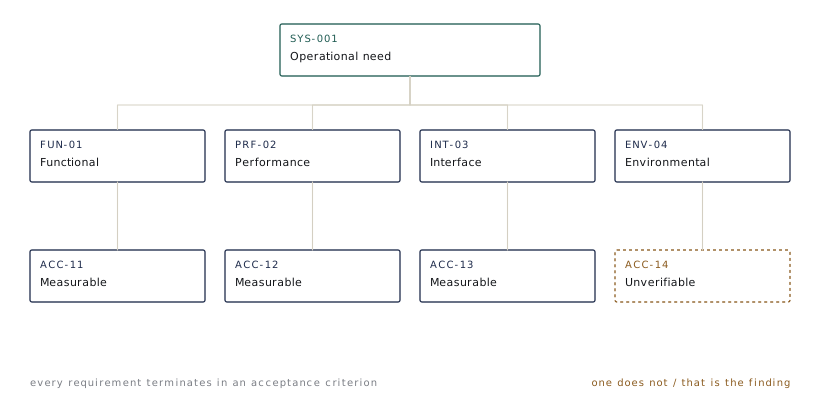
Most projects fail not in execution but in definition. Rigorous requirements — functional and non-functional — and a defensible architecture before a line of code is written. This is where expensive rework is prevented.

What this includes
  • Functional and non-functional requirements capture
  • System architecture design and validation
  • Interface definitions and protocol specifications
  • Risk assessment and mitigation strategies
  • Validation criteria and acceptance test plans

System troubleshooting & rescue.

Root cause analysis and lasting fixes for problems that have been around too long — RF interference, timing failures, protocol mismatches, mysterious integration gaps. Schematics read, signals analyzed, failures traced to actual sources. Every engagement ends with a client who understands exactly what happened and why.

What this includes
  • Root cause analysis and failure diagnosis
  • Signal analysis and protocol debugging
  • Communication network troubleshooting
  • Integration problem resolution and optimization
  • Emergency response and critical fixes

Bring the hard problem

If your situation lives in here, let’s talk.

Whether the scope is clear or you haven’t fully characterized it yet, the conversation starts the same way: tell us what you’re trying to accomplish and what’s standing in the way. The rest follows from there.